
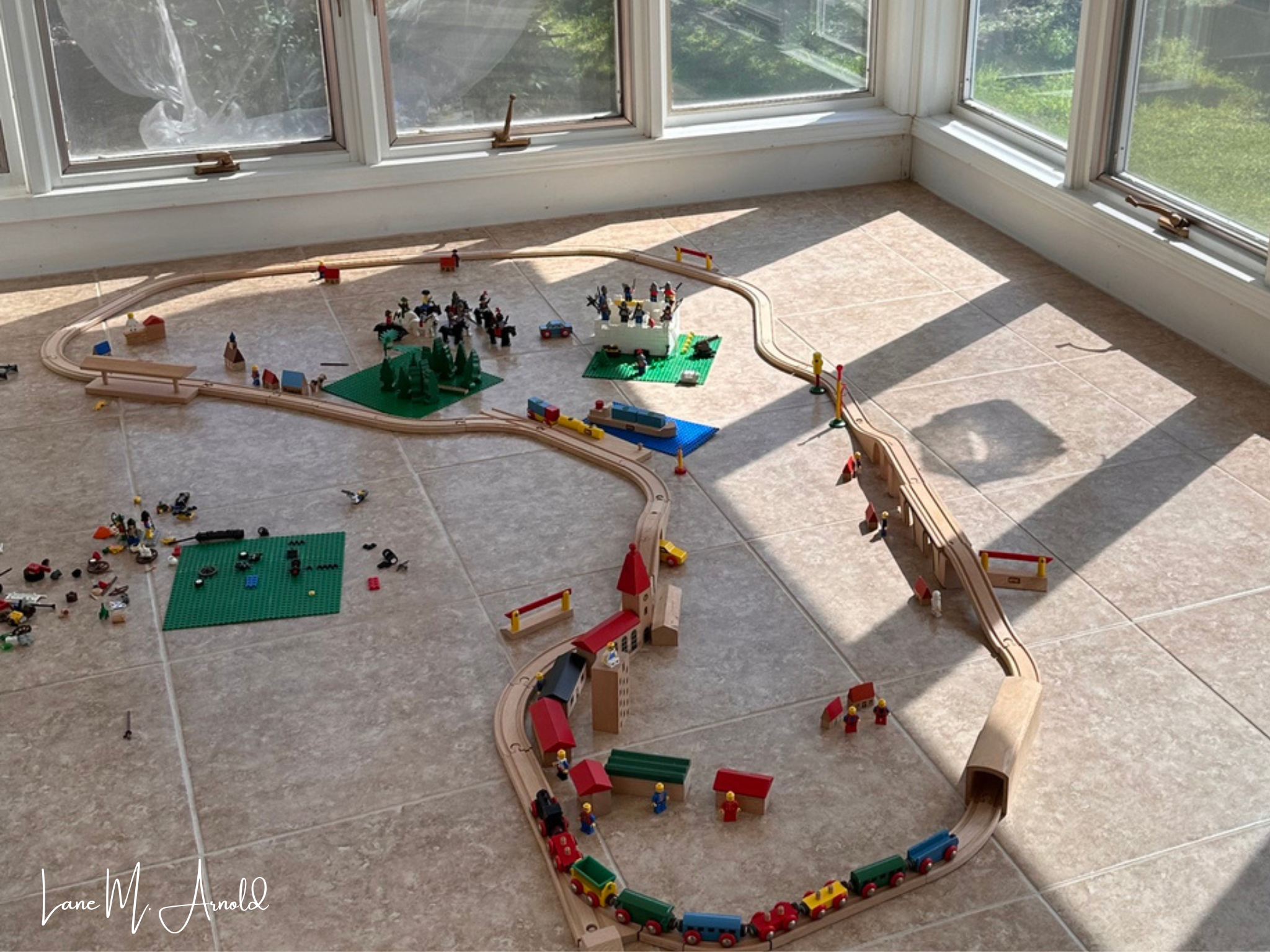
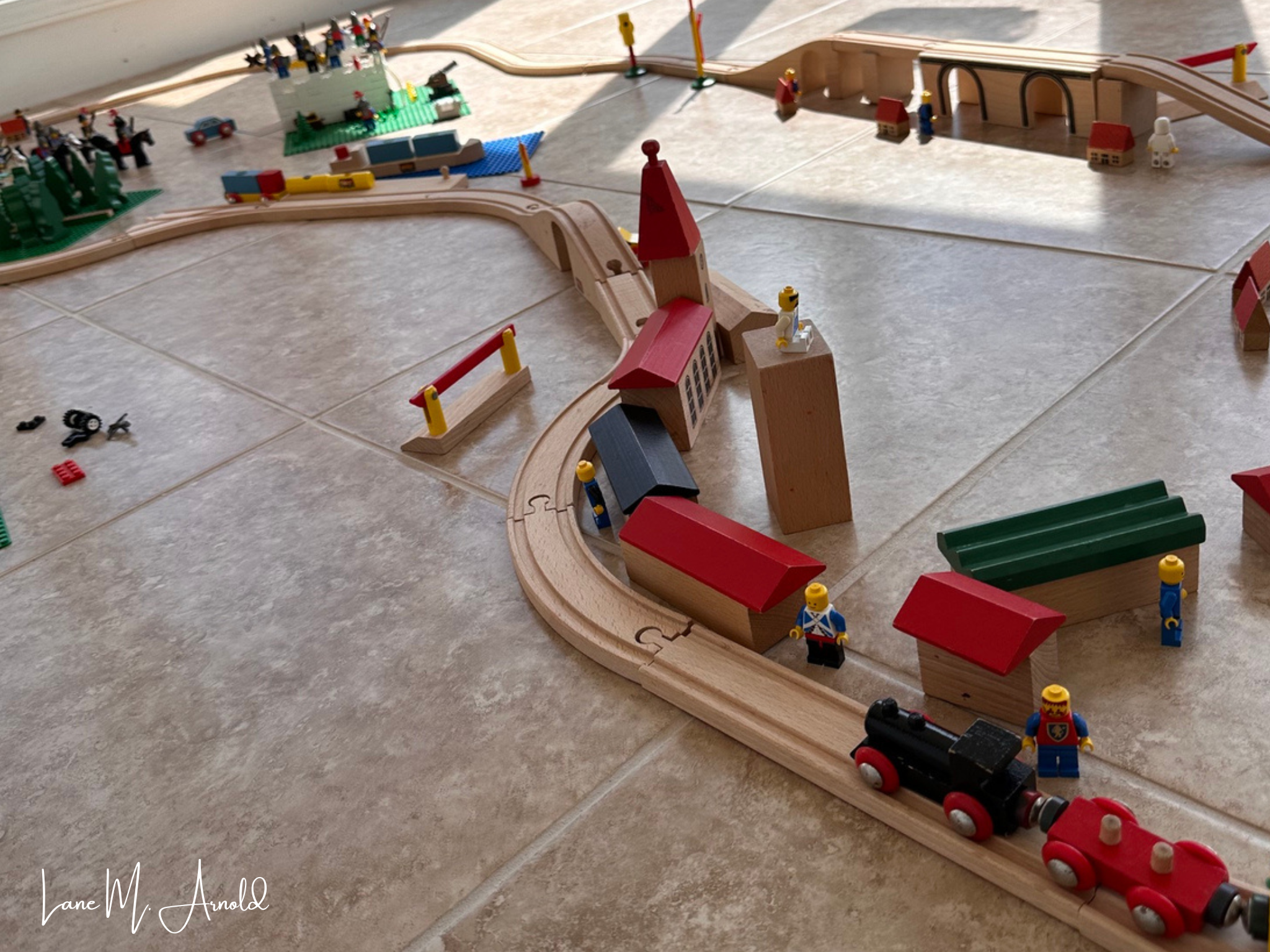
We live in a home with a railroad line and a village running through it. Truly.
Did I mention that it’s a smallish village encircled by a cozy wooden train track?
This summer, all the Legos and wooden train set pieces reside on the floor of our underused sunroom. It’s become the focal point of summertime visits from the local grandchildren.
“Should we move the bridge so it’s nearer the port?”
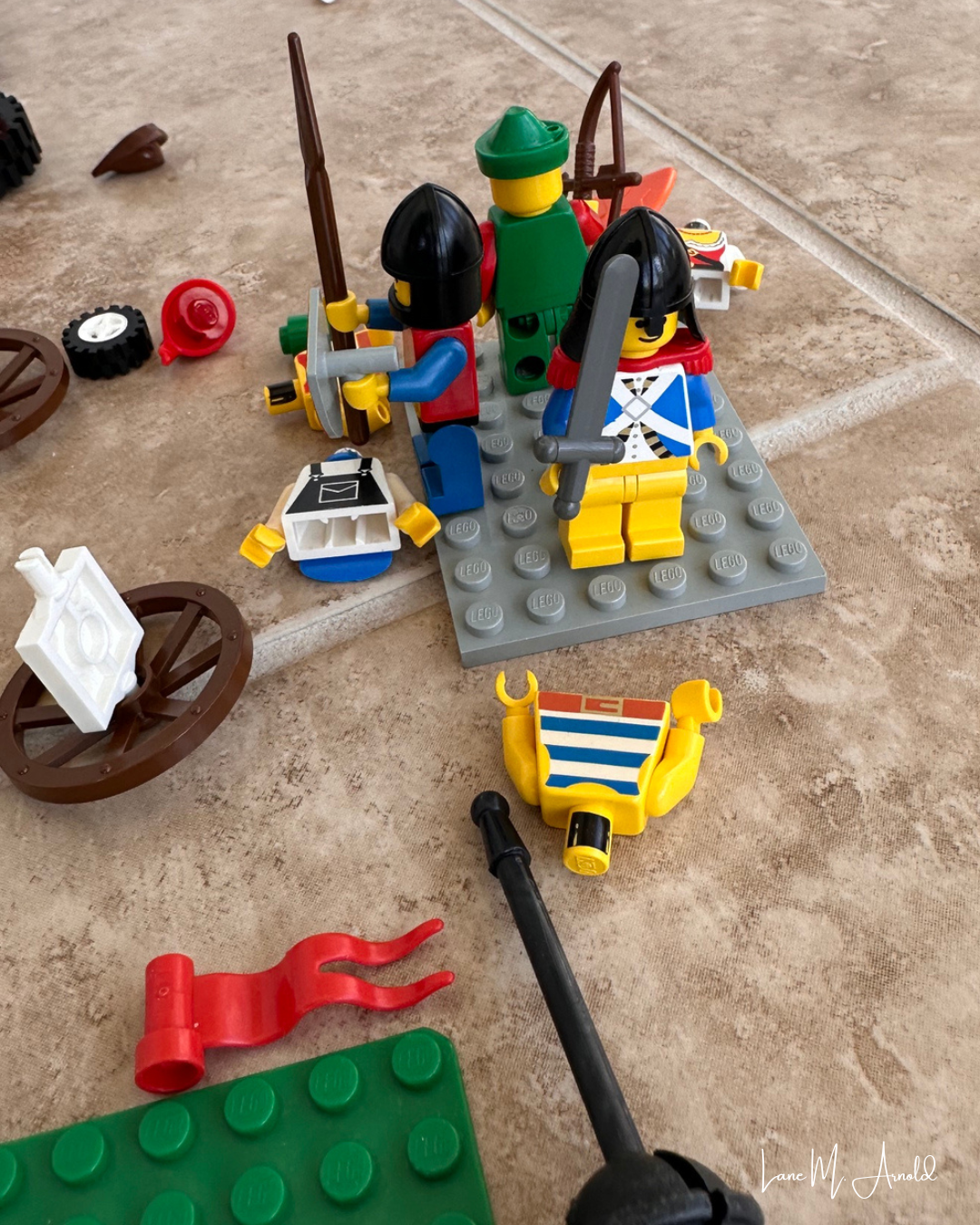
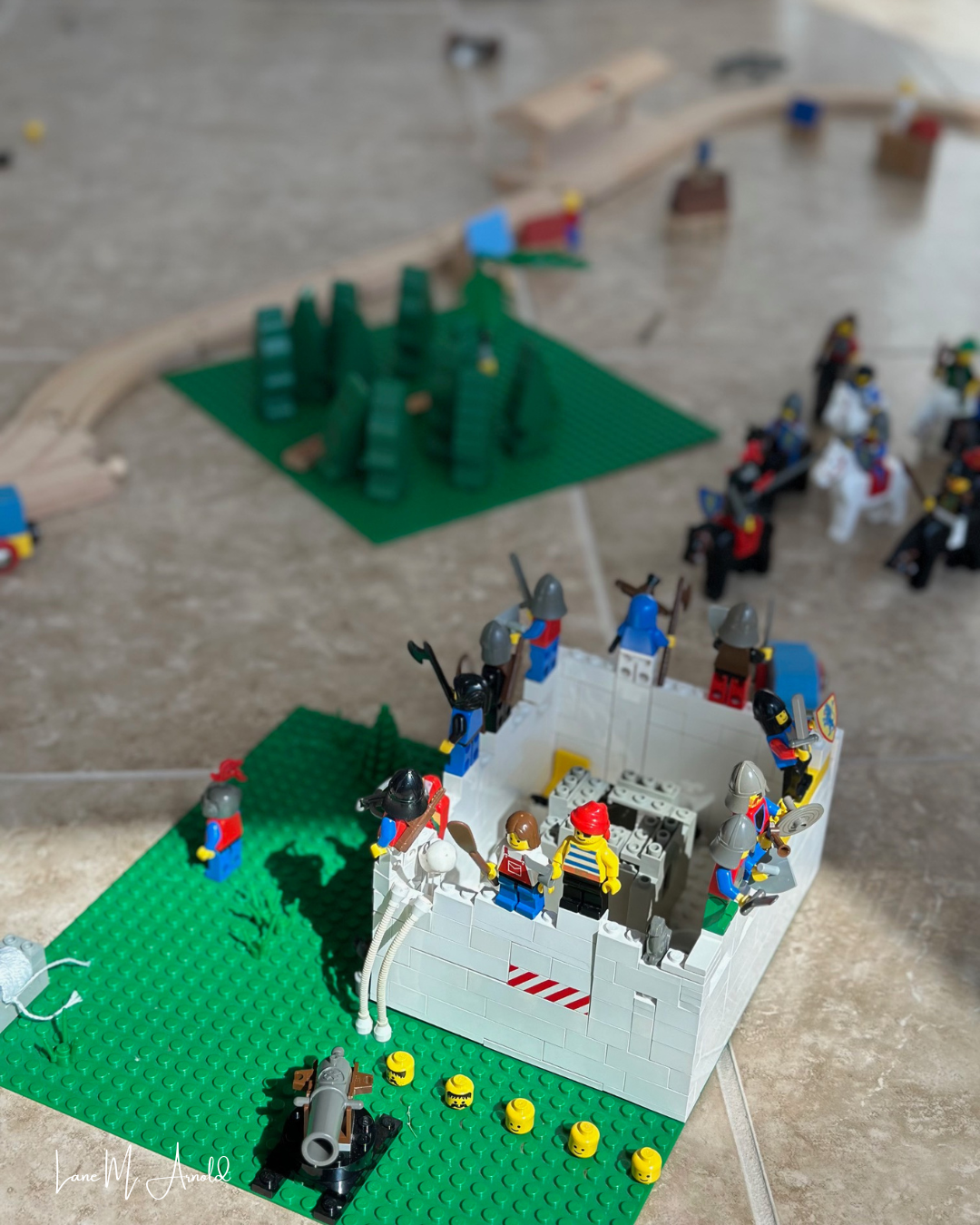
“Let’s find more knights to defend the castle.”
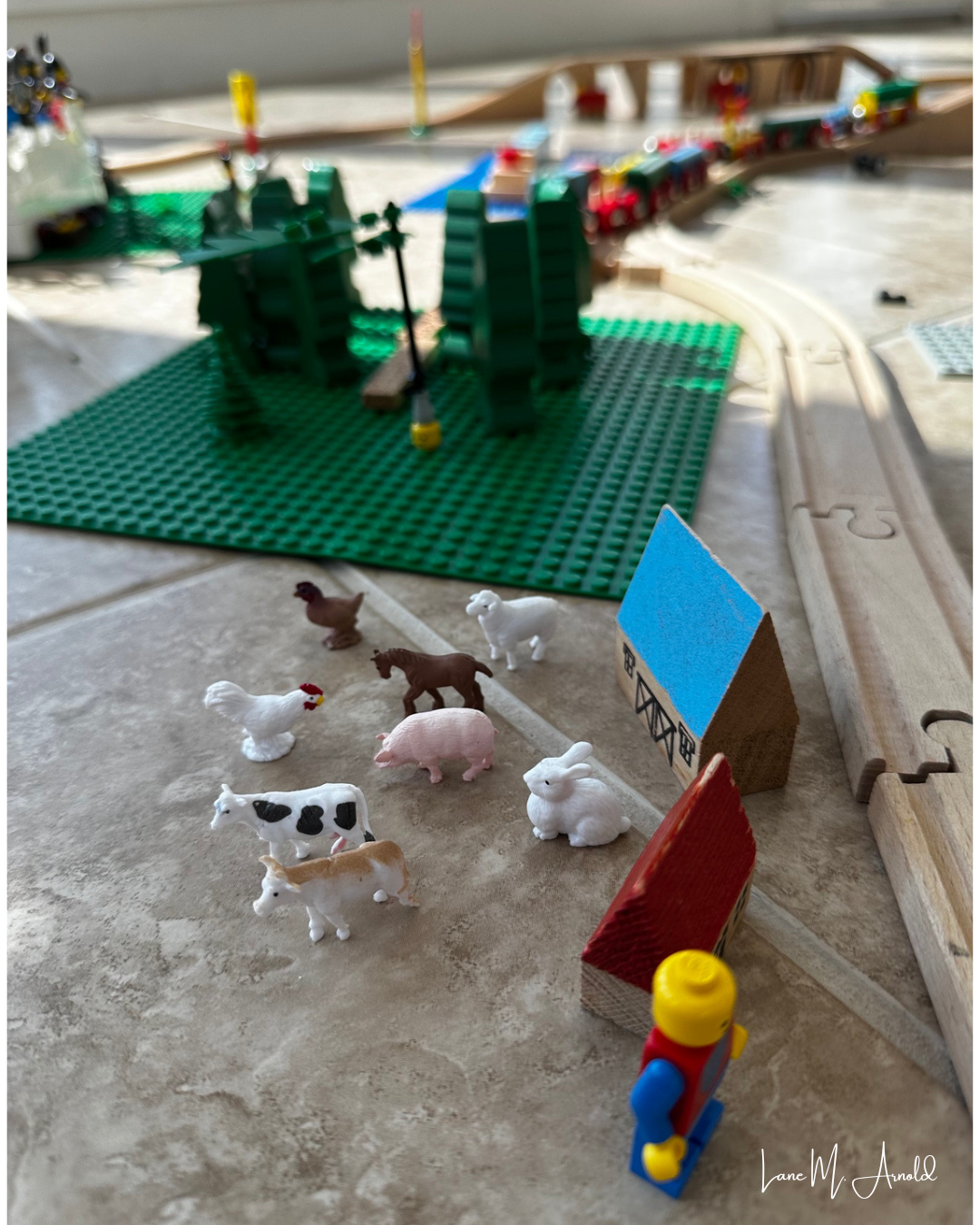
“Gran, do you have any more farm animals?”
“Would zoo animals work instead?” I reply. “There’s a jar of monkeys and cheetahs and such in the toy closet.”
The local grandchildren and I have immersed ourselves in inventing this village. We’ve engaged in its development and experimented with multiple design approaches.
With the sunroom’s spaciousness providing a new space for creative endeavors, the grandchildren now view our very familiar Legos and the train set with renewed playfulness. They have created a culture for their Lego kingdom, complete with rules for their village, much like a novelist might world-build in a manuscript.
Whether riding in the car between their house and ours, visiting the local UGA Aquarium to observe fish and touch horseshoe crabs in the touch tank, or playing ring toss in the backyard, the railroad and its village are the focus of conversation.
That’s what happens when we know something well. We become immersed in its way of being in the world.
Immersion invites curiosity, which leads to expansion. Expansion enlists our imagination. Imagination broadens our perspective. Perspective shifts our viewpoint.
What we immerse ourselves in matters, doesn’t it? As a young Christ-follower, I immersed myself in Scripture, memorizing verse after verse to hold onto as I entered a new worldview. Across the decades, Scripture, whether read or memorized, is the spring that continually refreshes my thirsty soul. When I am parched for more of God, His words quench me.
Long ago, when caring for my aging parents during an unexpected 17-month stretch, I read Psalm 90 every morning. I had no intention of memorizing it, yet God gently invited me to read it aloud each dawn. One day, I realized I no longer had to read it from the Bible itself because it had taken root within me through repetition, spoken over and over as the sun said good day.
One early summer morning, as I walked around the block, I suddenly remembered those dawns in Psalm 90 with God. Time spent in Psalm 90 invited me to its perspective and gave me a new way to think about familiar ideas.
I thought about how the old Legos and train set, so familiar to my grandchildren, have recently come to life in a new way through repeated time spent with them.
Seeing how familiar items took on new meaning once again prompted me to ponder what spiritual practice I wanted to revisit this summer.
Returning to Familiar Words
I met Jesus as a teenager, and since that day almost 60 years ago, I’ve savored the wit, wisdom, and wonder of the Bible’s stories. I’ve studied it. I’ve discussed and dissected it. Through Bible studies, small groups, and sermons, I’ve learned more about the Bible. Through Lectio Divina and Imaginative Prayer, the words of God have become words I explore, savor, and often pray back to Him. I am immersed in the language and love of Scripture. Yet one of the beauties of the Word of God is that what is so familiar can take on fresh meaning when the Holy Spirit offers it from a new angle.
I’m one who believes in regular spiritual rhythms to deepen and refresh my relationship with God. As such, I engage with practices that help transform me into who God imagines me to be. One occasional rhythm centers around the memorization of and meditation on words in the Bible. Yet it’s been a while since I stepped into it.
What would it be like to return to the familiar yet intermittent practice of memorizing and meditating on Scripture? How would such an invitation immerse me in familiar words in fresh ways? And could this 73-year-old brain still retain words as it once did in my teenage years?
The Slow Work of Learning by Heart
Yesterday, as I thumbed through Ken Ludwig’s book How to Teach Your Children Shakespeare, I reread this underlined passage:
“In order to memorize something, you have to be very specific and very honest with yourself. You have to work slowly, and you have to understand every word of what you’re memorizing. There was a time not long ago when memorization was considered to be one of the basic tools of an academic education. Students were expected to learn hundreds of lines from the Greek and Roman classics, then later, from poetry in their native tongues. This tradition has faded from our lives, and something powerful has been lost.” (p. 8)
Specific: This venture into memorization requires intentionality and discipline. Precision is essential.
Honest with oneself: Being courageous and self-aware about what I am trying to hold in my mind and heart means I can’t take shortcuts if I want to capture the goodness of each word I memorize.
Work slowly: Slow work means I am not aiming for a gold star in speed; rather, the aim is to marinate, taking time to soak in the Word.
Understand every word: It also means grasping what the words mean, though not with an exegetical slant. To move them out of rote recitation and into learning by heart, I need to comprehend their depth and how they will connect my heart to God’s heart.
Yet, the question remained: could I do this?
We Remember What We Love
Fear and doubt would certainly like to take the upper hand. Hesitation bobbed to the surface. I keep my brain active by having deep conversations, moving my body regularly, and exploring new ideas through reading and listening to others. Yet, I am rusty in this memorization arena.
There was a time when I knew everyone’s phone number by heart. Now I push a button, and my phone dials it for me. I haven’t memorized a Scripture or even a poem in a long time. Maybe this is beyond me right now?
Hmm. I’m rethinking this. Between us, my husband and I have a plethora of adult children, their spouses, and grandchildren. Somewhere in my memory bank, I have stored everyone’s birthdays and anniversaries. That’s good to remember.
Lisa Genova, in her book Remember: The Science of Memory and the Art of Forgetting, says, “You can only capture and retain what you pay attention to.” She adds that the primary cause of forgetting is our lack of attention. Yet she cautions that our brains default to inattentiveness. So, will I consciously choose to pay attention to the words I want to keep deep within me?
Then my thoughts turned to these questions. Is memorization something people even do anymore? Do kids still memorize poems like the ones Mrs. Valentine taught us in elementary school? Because of her love of poetry, every view of a daffodil finds me reciting Wordsworth’s first line, “I wandered lonely as a cloud…”
Do we tend to think that memorization is indeed a thing of the past? I’m writing this as the Wimbledon finals are complete and the last game of the World Cup is just days away. If we think people still don’t memorize much, all we need to do is talk to a sports fan. We’ll hear baseball statistics, football plays and scores, moments of wonder recalled from the Masters golf tournament, rugby scores from past games, and regatta scoring details.
Ask a birder what that tweedled-tweet is, and she’ll tell you the bird’s feathered field guide information. Interested in hiking 14,000-footers in the Colorado Rockies? Scores of hikers will spout off details on where to park, what middle-of-the-night hour to set out on the trail, how to navigate scree fields, and when you’d better be off the summit in order to avoid ferocious storms.
Rock climbers can tell you routes and handholds. Musicians and actors can hum any section of a tune and quote lines on demand from any play. A runner of Georgia’s Peachtree Road Race or Colorado’s Bolder Boulder will tell you not only her time for this year’s race but also her best-ever time, favorite race location, and favorite path in that particular race.
Talk to book lovers, and they’ll tell you which scene marks the protagonist’s transformation and which line serves as a pivot point. Encounter a retreatant who has recently finished the Spiritual Exercises of St. Ignatius, and they’ll tell you what interior landscape changes occurred in their heart during a particular Week or a particular Scripture experience during the long retreat.
What we are immersed in is easy to attend to, and our memory holds fast to those words, stats, lines, and notes. What matters to me is what I invest in.
When I think about this idea of returning to immerse myself in Scripture memory, it’s not only possible for this older brain of mine to do this type of spiritual practice, but it’s also vitally important. Listen to Dallas Willard’s words in Life without Lack:
“Memorizing Scripture is even more important than a daily quiet time, for as we fill our minds with great passages and have them readily available for our meditation, ‘quiet time’ takes over the entirety of our lives. Memorization enables us to keep God and his truth constantly before our minds, allowing his Word and wisdom to help us.”
Immersed in the words of Scripture, my mind gains easy access to what delights and guides me.
More Than Memorization
Whether for dawn walks when the world is quiet or for the noonday noise that seeks to unsettle my mind, having such easy access to these soaked-up words means they are always at hand. As I memorize parts of the Bible, I build scaffolding that lets meditation waft through my day. My mind is anchored by solid words that accompany me at any moment.
The point isn’t to memorize as I, ahem, might have done in college, grad school, or even seminary, where it was committed to short-term memory, to be remembered only for the exam.
Scripture memory is not catch-and-release; it’s keep-and-savor.
In the process of memorization, transformation also comes into play. God shapes me as I hover over His words. I let them haunt me with their deep invitations to life to the fullest.
If you spend any time reading books by Dallas Willard, Trevor Hudson, or Dave Ripper, you’ll encounter the central idea that we aren’t simply to plow through the Bible; instead, we are to let the Bible get through us. Immersion does that so well, doesn’t it?
All throughout Scripture, we are encouraged to make the Bible an integral part of who we are. We are to store it in our hearts (Psalm 119:11; Proverbs 7:1-3), meditate on it regularly (Joshua 1:8; Psalm 1:1-3; Psalm 119:97), let it shape our lives (Colossians 3:16; James 1:22-25), speak it to others (Deuteronomy 6:6-9), and trust in its purpose and power (2 Timothy 3:16-17; Hebrews 4:12).
So, what are some ways we can immerse ourselves in learning Scripture? We can read it silently and speak it aloud, write it line by line or use only the first letter of each word, write a whole book at a time, act it out with hand motions, or sing it to a familiar tune. We can pray the passage, line by line, over ourselves and over those we love. What would you add to this list?
Finding a Way That Fits You
Let me share one way that helps me as I reinvest in memorization.
I visualize a real-life location, scene by scene, then playfully and imaginatively walk through that familiar spot, letting mental images form as companions along the way to the verses I want to learn.
I’ll illustrate this with the passage I’m savoring from James 1:1-5, using a real beach scene, beach-lover that I am.
As I leave my car at the start of the beach path, I imaginatively see James, dressed in a server’s apron, handing out invitations to twelve families worldwide.
- James, a servant of God and of the Lord Jesus Christ, to the twelve tribes scattered among the nations: Greetings.
On the boardwalk, missing planks offer unexpected places to hop, skip, or jump, nearly making me lose my sandal, while marsh crabs skitter across the boards, making me laugh despite the challenges underfoot.
- Consider it pure joy, my brothers and sisters, whenever you face trials of many kinds,
At the shore, I watch a surfer stand on her board, then tumble, stand again, then tumble, until she finally steadies and then catches a wave and rides it all the way into shore.
- because you know that the testing of your faith produces perseverance.
Nearby, two children build a sandcastle, repairing it repeatedly as waves keep knocking down its walls.
- Let perseverance finish its work so that you may be mature and complete, not lacking anything.
Not sure whether the tide is ebbing or flowing, I ask the lifeguard, who offers guidance.
- If any of you lacks wisdom, you should ask God, who gives generously to all without finding fault, and it will be given to you.
Our brains often remember places and visual images with ease, so this playful method makes it easier to recall the verses. With that experience of walking from the car to setting up a spot on the beach, I’ve immersed myself in memorizing James 1:1-5.
What works for you when you want to immerse your mind in Scripture memory? Do you like to jot verses on sticky notes or index cards? Do you post them around your house so you can learn them while brushing your teeth after breakfast or while sitting at the computer after a long client call?
I like taking one verse and walking it around the block as I travel through the neighborhood at dawn. It’s my focal point as I walk. Then, during the day, I write it out by hand in a notebook and later recite it to a friend.
The more I immerse myself in Scripture, the more I learn its culture and flavor, and the more it transforms my heart.
Learning the Landscape of God’s Heart
What makes the afternoons with the Lego village and the little train special isn’t that we built something. It’s that we have lived in it for a while. We enter its world. We know every railroad crossing, every uneven train track connection, and where every tiny animal is tucked between trees and fields. The more time we spend there, the more delightful it becomes. In a sense, we have learned it by heart.
Scripture memory invites us to a joyful familiarity as well. I don’t want to learn a bunch of verses just to say I did it. I’m not doing this to gain accolades or collect proverbial gold stars. I want to know the landscape of God’s heart.
I long for His word to accompany me as I walk around the block, wash the dishes, and take out the trash. I want my 3 AM worries to dissipate because a verse that inhabits me shows me how to think and live differently. I want to abide in God’s way of thinking, so my desires are reshaped by His and my character is formed through interactions with Him. He always has more to say, and I want to be always listening.
- Jesus, what words of Yours do you long to write on our hearts so they become our first thought in every joy and every trial?
- Father, what words do You want me to dwell on so that the loud voices of the world do not drown out the words of Your heart?
- Holy Spirit, what words would immerse me in the culture of the kingdom and the family of God at every turn along the path of my day?
May we discover together how the joy of Scripture memory resides in the Christ we come to know. Like my grandchildren, who return again and again to the world they have built, let us return to God’s Word and immerse ourselves there. Let us rejoice in discovering that it is building us into people who are dearly and deeply familiar with God and His Words, meant to dwell deep within us.
